
Camellia NSW 2142
Camellia, NSW 2142 is a small Parramatta-side suburb in Sydney’s Parramatta & Hills region, governed by the City of Parramatta Council. It is characterised by an industrial-residential setting with river and creek frontage, low tree canopy cover at 11.59%, and limited lifestyle amenity, reflected in low retail and walkability ratings but slightly better cultural access. Public transport is a relative strength, with many bus services and Parramatta Light Rail L4 stops at Rosehill Gardens and Camellia, while commute times are about 65 minutes by public transport and 30 minutes by car to the CBD. Westfield Parramatta is the main major shopping centre serving the area.
The mix of houses and apartments that make up the Camellia NSW 2142 property market, and the sale price range each achieved over the past 12 months.
How close Camellia NSW 2142 properties sit to major roads or rail, and how much traffic noise that brings compared to properties set back from them.
Train, metro, light rail, ferry and B-Line services accessible from Camellia NSW 2142.
"Houses" in this report includes detached houses, duplexes, and terraces.
How house lots across Camellia NSW 2142 sit relative to street level — topography that affects drainage, flood risk, privacy, and build cost.
See which key planning overlays and environmental risks affect this suburb before you buy.
The share of Camellia NSW 2142 houses within easy walking distance (1.2km) of a train station.
Typical land characteristics and common property features across Camellia NSW 2142.
How property prices vary across the different pockets of Camellia NSW 2142, and how each pocket compares.
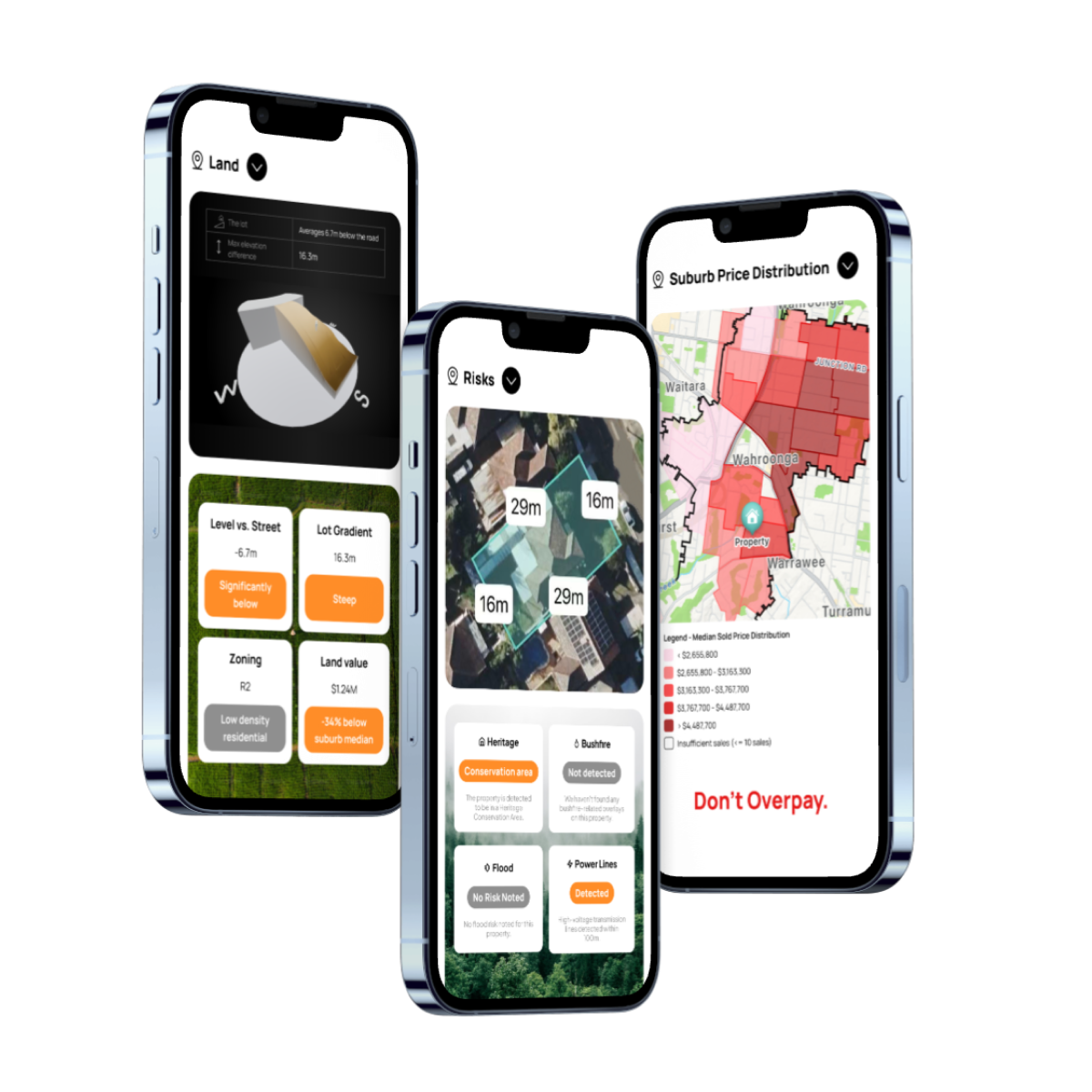


Where apartment projects are concentrated across Camellia NSW 2142, with project-level sales context.
The median weekly rent for apartments in Camellia NSW 2142.
The largest apartment projects in Camellia NSW 2142, ranked by number of lots.
Median age, household income, and the renter-versus-owner split that shape the Camellia NSW 2142 community.
Get the knest.ai app
Gain ultimate insights into any property
Buyer-focused property platform identifying risks, price estimates, 3D land maps and more to help you make smarter decisions — completely free.

Living in Camellia NSW 2142: Suburb Profile & FAQs
Common questions about living in and buying property in Camellia NSW 2142 — lifestyle, transport, schools, and the housing market.
Note: Data is sourced from the Australian Bureau of Statistics (ABS) 2021 Census data and knest.ai internal statistical data.
Is Camellia NSW 2142 a good suburb for families?
Camellia NSW 2142 is a weaker option for families in most buyer scenarios. The clearest reason is that the suburb scores very low on safety at 1 out of 5, and its residential profile is extremely limited, with an average household size of 0 and no meaningful house or apartment share showing up in the local mix. That makes it hard to describe Camellia as a typical family-friendly suburb, even though its school ratings are relatively strong on paper at 6 out of 5 for primary and 8 out of 5 for secondary in the supplied data. For buyers searching for a good suburb for families, good for kids, and balanced around schools and safety, Camellia looks mixed at best and usually less suitable in practice. The trade-off is that families who care more about access to the wider Parramatta area than about a settled neighbourhood feel may still keep it on the radar, but most owner-occupier family buyers will likely prefer more established nearby residential suburbs.
What is it like to live in Camellia NSW 2142?
Living in Camellia NSW 2142 feels industrial, practical, and highly urban rather than village-like or residential. The suburb character is described as industrial-residential, and the environmental setting is shaped by river or creek adjacency rather than leafy streets, with canopy cover at just 11.59%. Day-to-day lifestyle indicators are also modest, with walkability 1 out of 5, retail 1 out of 5, culture 2 out of 5, and safety 1 out of 5. In plain terms, Camellia is not the sort of suburb buyers usually choose for café culture, strolling to shops, or a calm family-oriented streetscape. The upside is that some buyers may value its position near major employment and growth areas around Parramatta, and the river-side setting adds a geographic point of interest. The trade-off is obvious though: if you want an established neighbourhood lifestyle with convenience and amenity at your doorstep, Camellia is likely to feel too sparse and too utilitarian.
Is Camellia NSW 2142 well connected for commuting?
Camellia NSW 2142 is reasonably well connected for commuting, but the transport picture is mixed rather than seamless. It does not currently have train service, and metro is also not available, so buyers looking specifically for direct train access or metro access will not find that here. However, Camellia does have light rail service on the L4 line and many bus services, which improves local movement and links into the broader Parramatta network. The average commute to the Sydney CBD is around 65 minutes by public transport and about 30 minutes by car, so driving is notably quicker. That makes Camellia more workable for commuters who rely on a car or who are heading to Parramatta and surrounding employment areas rather than the CBD every day. The trade-off is that compared with stronger rail-based suburbs, commuting from Camellia can involve fewer transport modes and less simplicity, especially for buyers who want a straightforward public transport trip into central Sydney.
Who does Camellia NSW 2142 suit best?
Camellia NSW 2142 suits a narrow group of buyers best, particularly those who are more focused on strategic location and access around Parramatta than on traditional suburban liveability. The area does not present as a typical family-house market or a classic apartment lifestyle precinct, and the supplied data shows no meaningful established residential housing mix. That means Camellia is less likely to suit buyers wanting a settled neighbourhood, a strong community feel, or a classic family-friendly suburb with everyday amenity close by. Occupationally, the local profile points toward managers, professionals, and technical or trades workers, which suggests a more work-oriented pattern than a conventional residential one. In buyer terms, Camellia may appeal more to pragmatic purchasers who understand the area’s unusual character and are comfortable with a highly urban, infrastructure-led setting. The trade-off is that lifestyle-driven buyers, especially families and those wanting walkable convenience, will usually find better alignment in nearby suburbs with a fuller residential identity.
What are the pros and cons of living in Camellia NSW 2142?
The main trade-off in Camellia NSW 2142 is that you get access to a strategically placed, infrastructure-linked area, but you give up a lot of the everyday lifestyle appeal most owner-occupiers want. On the plus side, Camellia sits in the Parramatta and Hills region, has many bus services, light rail access on the L4, and a relatively manageable 30-minute drive to the CBD. It is also adjacent to river or creek environments, which gives the area a natural edge despite its urban form. On the downside, the lifestyle scores are low: walkability is 1 out of 5, retail is 1 out of 5, culture is 2 out of 5, safety is 1 out of 5, and tree cover is only 11.59%. So the disadvantages of living in Camellia are mostly about limited amenity, a sparse residential feel, and a less polished day-to-day environment. Buyers who prioritise function over charm may still see value here, but lifestyle-focused households will care about those compromises most.
What are property prices like in Camellia NSW 2142?
Property prices in Camellia NSW 2142 are hard to characterise in the usual Sydney suburb sense because the recent six-month sales search returned no suburb-level sales statistics. In practical buyer terms, that usually means Camellia is not behaving like a normal, active residential market with enough recent settled sales to form a clear house price or apartment price benchmark. For anyone researching property prices in Camellia, house prices in Camellia, or whether Camellia is expensive, the key takeaway is that pricing transparency appears limited rather than simply cheap or expensive. That creates a different kind of buying pressure: not necessarily broad competition, but more uncertainty around what represents fair value. The trade-off is that a less standard market can sometimes interest buyers with a very specific brief, especially those thinking about location and future area change, but most mainstream buyers prefer suburbs where recent residential sales provide clearer guidance on value and budget expectations.
36 surrounding suburbs near Camellia NSW 2142
5 streets in Camellia NSW 2142