knest.ai • Property intelligence for home buyers
Can You Build a Duplex on This Block? How Buyers Check Duplex Potential
Can I build a duplex on my land? In Australia it comes down to three layers, wherever the block is: your state’s planning rules, the zone your block sits in, and the block-level detail — the governing instrument’s numbers, usually your council’s, plus the overlays on the land itself. Your state gives you a free official way to check the first two layers in minutes, before you spend a dollar.
If you’re weighing up a block partly because it might take a duplex one day, that potential has a price built into it. Before you bid, the question isn’t whether you’d win an approval; it’s whether the potential priced into the listing is real enough to pay for. This page is how you check, free. A builder’s feasibility page can be a useful first screen, but it is also selling you a build. The map has nothing to sell.
- No national rule decides duplex potential. Start with your state: the state sets the instrument, the zone sets what’s allowed, and the council usually sets the numbers.
- A yes on zoning is not an approval. It means the door is open for an application your council will still assess.
- Lot size, frontage and the other standards in the governing instrument can rule out a block whose zone says yes.
- Overlays such as heritage, flood and bushfire can change the approval pathway, or rule out what the zone would otherwise allow.
Can I build a duplex on my land?
Sometimes. The honest answer starts with which state the land is in. New South Wales gives the clearest state-level yes. Since 1 July 2024, dual occupancies are “permitted with consent in R2 zones state-wide” (NSW Department of Planning, Housing and Infrastructure, 2025). That yes carries exclusions: hazard-affected land, heritage items and four council areas, covered below. The Northern Territory answers no in its single-dwelling zone, and removed the provisions that used to say yes. Most of the country sits between those poles.
“With consent” is the phrase to hold onto. It means the council still assesses an application. Nothing is automatic. And a state-level yes never finishes the job, because your block’s zone and your council’s own standards decide whether this block qualifies.
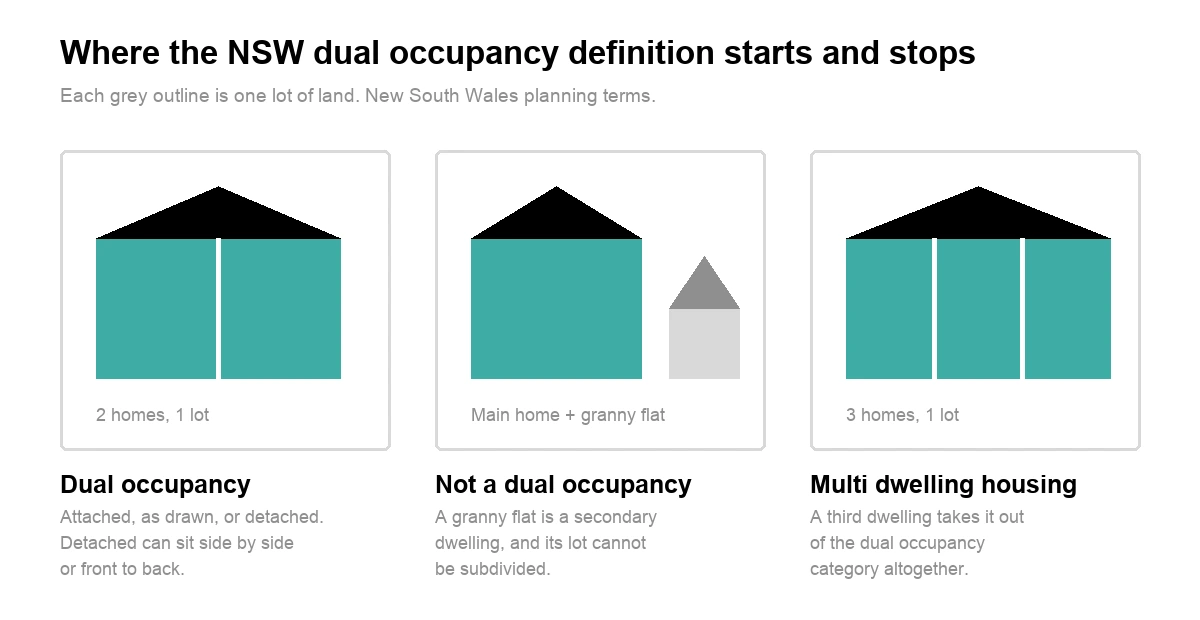
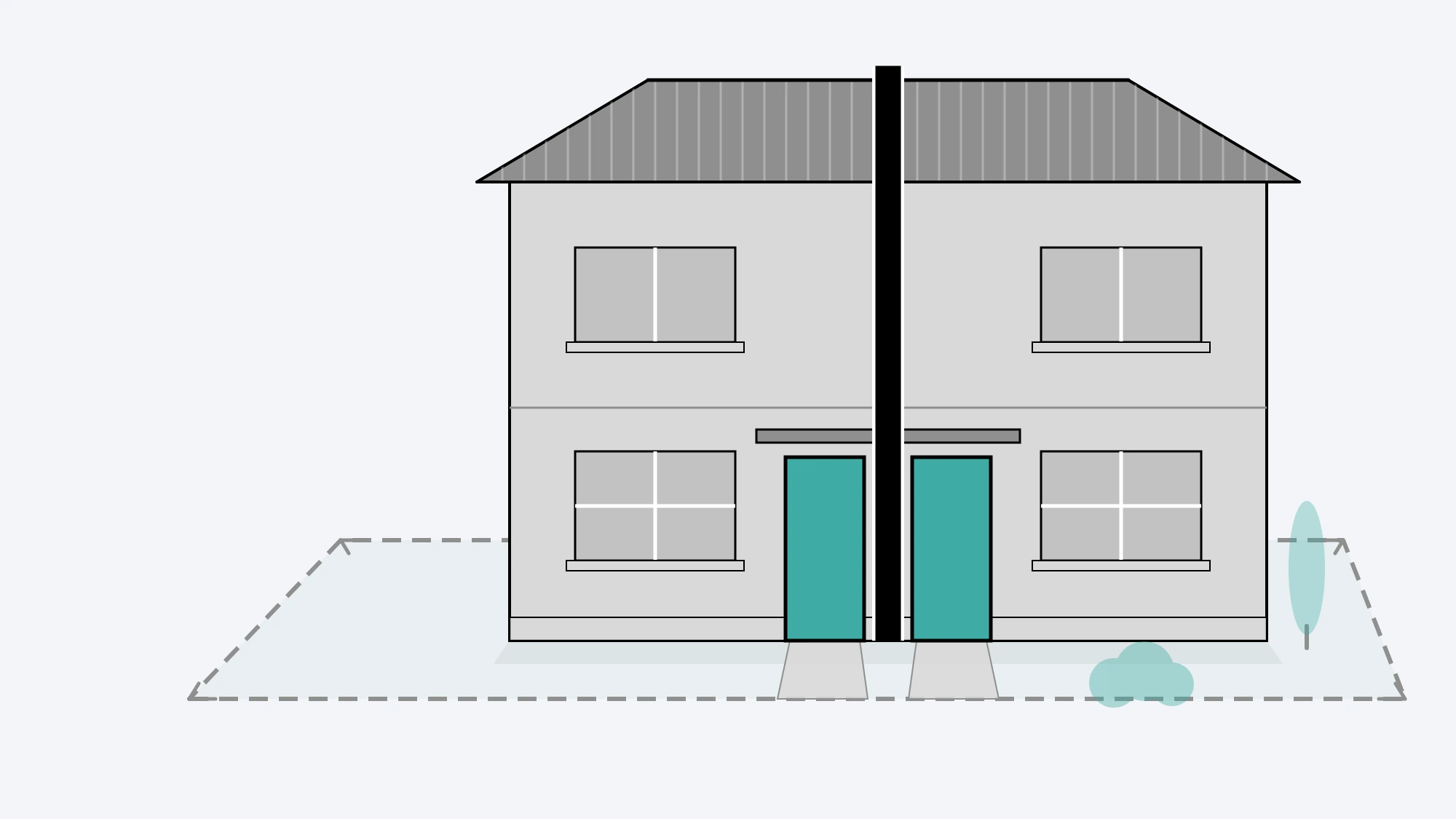
A duplex here means two attached homes on one parcel, but planning systems don’t all use that label. New South Wales assesses the pair as a dual occupancy. Western Australia treats it as grouped-dwelling development under its design codes. The ACT’s 2023 change speaks of a second dwelling on the block. Where a jurisdiction regulates two homes on one parcel under its own name, that category is the one this guide tests. The buyer question underneath stays the same: can this block lawfully hold two homes? If the wider picture is new to you, start with what a duplex is in Australia and come back to the block-level question.
The four checks to run before you bid
Whatever the state, the screen is the same four moves: find the zone, read what it permits, check the numbers, check the overlays. Each one is free, and each uses a page the planning authority itself publishes.
- Find the zone on the official map. Every jurisdiction publishes a free lookup; the table below is your state’s front door. Search the address and write down the zone code exactly as the map states it.
- Read what the zone permits. In the NT “each zone has an assessment table” telling you the assessment category and requirements (NT Government). The zone page, not the sales brochure, is where duplex potential becomes a yes, a no, or a maybe with consent.
- Then go to the numbers. Minimum lot size, width and the local standards live in the governing instrument: the LEP in New South Wales, the council planning scheme in Queensland, the density code tables in Western Australia. In South Australia and the ACT the numbers sit in the jurisdiction’s own code, the Planning and Design Code and the Territory Plan. This is the layer that turns allowed-in-the-zone into allowed on this block.
- Check the overlays last. Tools like VicPlan and City Plan online display them next to the zone, and the constraint layers — heritage, flood and bushfire — can quietly close a door the zone left open.
| Where | Official lookup |
|---|---|
| NSW | The Spatial Viewer on the NSW Planning Portal, with maps of the planning matters affecting each address and lot (NSW Department of Planning and Environment) |
| VIC | VicPlan, which generates a planning report showing the zone and overlays for any Victorian property (VIC Department of Transport and Planning) |
| QLD | Your council’s planning scheme map. In Brisbane, City Plan online (Brisbane City Council) |
| WA | PlanWA, the public mapping tool for planning, land and heritage data across the state (WA Government) |
| SA | SAPPA, which displays current zoning across South Australia (PlanSA) |
| TAS | The Tasmanian Planning Scheme pages published by the Tasmanian Planning Commission (Tasmanian Government) |
| ACT | The Territory Plan and the ACT’s get-to-know-your-block resources (ACT Government) |
| NT | The ‘town planning’ zones layer on NT Atlas (NT Government) |
Three things to write down
What you’re looking for is boring by design: the zone code, the overlay list, and the name of the instrument that governs the numbers. Write those three things down. They turn every later conversation with an agent, a planner or a builder from vague potential-talk into a request to show you where the scheme says so.
A ten-minute official-map check can tell you whether the advertised potential survives the first planning screen, and it costs nothing.
Why isn’t the zone the whole answer?
Because a block’s answer is built from three layers, and the zone is only the middle one. The other two can each change the result.
Layer one is the state instrument. In New South Wales that’s the Low and Mid-Rise Housing Policy, part of the State Environmental Planning Policy (Housing) 2021 (NSW DPHI, 2025). In Western Australia it’s the Residential Design Codes, which “set out planning and design requirements for residential development across Western Australia” (WA Government, 2026). South Australia writes its rules in one book: “Zoning is set out by the Planning and Design Code under the Planning, Development and Infrastructure Act 2016” (PlanSA).
Layer two is the zone. Zones decide the kinds of housing a block can carry, and the same street can change answers where a zone boundary runs. Canberra shows how specific this gets. RZ1, its lowest-density zone, covers “79.7% of residential blocks in the ACT” (ACT Government). The 2023 Territory Plan drew a numeric line straight through that zone. Over 800 square metres, a Canberra block can now take a second dwelling of up to 120 square metres. Under that line, the 2023 change doesn’t apply.
Layer three is site-specific: the numbers in the governing instrument, plus the constraints mapped over the land itself. The numbers are minimum lot size, frontage and the local standards, usually the council’s. The constraints are the overlays, heritage, flood and bushfire among them; they get their own section below, because they can undo what the zone appears to allow.
Tasmania runs the same three layers under different names. One statewide scheme sets “a consistent set of planning rules”, and each council’s Local Provisions Schedule “applies the rules to a specific council area” (Tasmanian Government). Different vocabulary, same lesson: the state writes the menu, the council sets your serving.
The layer buyers miss
The third layer is where a single quoted number misleads. New South Wales shows how the layers stack. Under its complying-development code, these housing types “will only be permitted in R1, R2, R3 and RU5 zones where councils already allow them under their Local Environmental Plan” (NSW Planning Portal, 2023). The development “must meet the minimum lot size requirements under the relevant council LEP”. The code’s 400-square-metre fallback applies only where “the LEP does not specify a minimum lot size”. The 400 is a floor for silent LEPs, not a state minimum. Treating it as the rule is the mistake to watch for whenever a single number is quoted for the whole state.
Where do I check the rules in my state?
There is no national duplex rule, and planning systems don’t use “duplex” consistently. This table follows each jurisdiction’s closest category for two dwellings on one block. The block-level answer sits in a different instrument or local scheme in each of them. Use the table to find where your first check starts.
| Where | First rule or category to check | Where to check the block |
|---|---|---|
| NSW | Dual occupancy is permitted with consent in R2 zones state-wide, subject to stated exclusions | The council LEP first: the applicable minimum lot size and other local controls (NSW DPHI; NSW Planning Portal) |
| VIC | Two dwellings on a lot are assessed under the applicable planning scheme | The planning scheme, looked up through VicPlan (VIC Dept of Transport and Planning) |
| QLD | Rules sit in the local planning scheme. In Brisbane, for example, dual occupancy is code-assessable in specified residential zones | Your council’s planning scheme; Brisbane’s is read through City Plan online (Brisbane City Council; Queensland Government) |
| WA | Look for the grouped-dwelling rules: a duplex pair is grouped-dwelling development under the R-Codes’ Volume 1 | The R-Codes are “administered and applied by local government”; the density code’s numbers sit with the council (WA Government) |
| SA | Start with the property’s zone and the policies that apply to it under the Planning and Design Code | The Code itself; SAPPA shows the zone for any address (PlanSA) |
| TAS | The State Planning Provisions set the rules; each council’s Local Provisions Schedule applies them to its area | The council’s Local Provisions Schedule (Tasmanian Government) |
| ACT | Check the zone’s rules under the Territory Plan | The Territory Plan (ACT Government) |
| NT | Check whether the zone permits the dwelling form at all; Zone SD’s purpose is single dwellings | The NT Planning Scheme’s zone assessment tables, via the NT Atlas lookup (NT Planning Commission; NT Government) |
That is why a useful answer starts with the jurisdiction and the block, not a national minimum-lot-size rule.
What knocks a duplex out, even in the right zone?
Constraints sitting on the land, rather than in the zoning column. New South Wales is explicit that its policy “does not apply to properties that are affected by certain hazards and constraints” (NSW DPHI, 2025). The department’s list names “land with a high risk from natural hazards like bushfire and floods”. It names land “close to dangerous goods pipelines and high aircraft noise”, and “land that contains a heritage item”. It also carves out four whole council areas: Bathurst, Hawkesbury, Blue Mountains and Wollondilly.
Corner blocks deserve one honest note here. They get called duplex sites in listings. The geometry can genuinely help, with street frontage on two sides and separate entries made easy. But a corner changes the shape of what you could build, not the rules about whether you can. The zone and the council’s standards answer that, the same as for any block on the street.
Victoria applies the same logic to its fast lane, the VicSmart permit pathway: “If other planning controls apply like heritage or flooding controls, the application may not be eligible for VicSmart” (VIC DTP, 2025). An overlay doesn’t always kill the duplex. Often it just pushes the application into a slower, harder assessment.
Those overlays are exactly what the map tools display, and what a planning certificate spells out for the land itself. Reading those documents is its own skill, and that guide covers it so this one doesn’t have to.
Do I need a development application, or is there a faster pathway?
Sometimes there is a faster pathway, but being allowed in the zone does not automatically make a project eligible for it. In New South Wales, some dual occupancies can proceed as complying development where the development is permitted and the proposal meets the applicable standards (NSW Planning Portal, 2023). Otherwise, a permissible proposal may need the development application pathway.
Victoria uses a different mechanism. Eligible applications for two homes on a lot can use VicSmart. The state says they “can receive approval within 10 business days” (Victorian Department of Transport and Planning, 2025). Neighbour notification is not required. It is still a planning permit, not permission to build without approval.
For the approval pathways in detail, see dual occupancy explained.
Before you pay for duplex potential
Build cost is a separate question from whether the block can take a duplex. Construction costs depend on the project itself; our guide to what it costs to build a duplex covers that side.
“Duplex potential” in a listing is a marketing claim, not a planning determination. If that potential is influencing what you are prepared to pay, run the checks above before you bid. Price the potential that survives the planning screen, not the words in the ad.
The buyer’s version of this check
You’re not applying for anything. You’re deciding whether advertised duplex potential is strong enough to factor into what you are prepared to pay. The first planning screen does not give you an approval; it tells you whether that potential survives the basic checks and is worth investigating further.
Run those checks before you bid, not after settlement. Look up the zone, check whether two dwellings are permitted, check the applicable lot and site standards, then check the overlays and other constraints affecting the block. If the screen rules the development out, don’t price that potential into your offer. If it survives, treat that as a reason for further due diligence, not as permission to build.
A knest.ai property report brings together the property’s zoning, land size and key heritage, bushfire and flood information in one place. Use it as your first screen, then confirm the planning rules that determine what can actually be built.
View a sample property reportFrequently asked questions
What is the minimum land size to build a duplex?
There is no national minimum, and in New South Wales the council’s Local Environmental Plan is checked first. The NSW Planning Portal states the development must meet the LEP’s minimum lot size, and only if the LEP does not specify one does the complying-development code apply a 400 square metre fallback. Elsewhere the numbers sit with council planning schemes and density codes, or with the jurisdiction’s own planning instrument, as in South Australia and the ACT.
Can I build a duplex on my land in NSW?
The NSW Department of Planning, Housing and Infrastructure says dual occupancies are permitted with consent in R2 zones state-wide, since 1 July 2024. With consent means the council still assesses an application, and the policy excludes hazard-affected land, heritage items and the Bathurst, Hawkesbury, Blue Mountains and Wollondilly council areas.
How do I find out my block’s zoning for free?
Use your state’s official lookup: the Spatial Viewer in New South Wales, VicPlan in Victoria, PlanWA in Western Australia, SAPPA in South Australia, City Plan online in Brisbane, the NT Atlas town-planning layer in the Northern Territory, the Tasmanian Planning Commission’s scheme pages, and the ACT’s get-to-know-your-block resources. Each of them is free, and each comes from the planning authority itself rather than a sales page.
Does a corner block make a duplex easier?
Sometimes, because access and frontage can work in its favour, but the zone and the council’s standards still decide. A corner position changes the geometry, not the planning rules that apply to the land.
Is a duplex allowed in the lowest-density residential zone?
Often not. Brisbane’s dual-occupancy list does not include its Low density residential zone, Victoria’s VicSmart pathway excludes its Low Density Residential Zone, and the Northern Territory removed dual-occupancy provisions from its single-dwelling zone in 2017. New South Wales runs the other way: dual occupancy has been permitted with consent in its R2 low-density zone state-wide since 1 July 2024, outside the policy’s exclusions for hazard-affected land, heritage items and four council areas.
Sources
- NSW Department of Planning, Housing and Infrastructure, Low and Mid-Rise Housing Policy, updated 16 July 2025, retrieved 2026-08-21, https://www.planning.nsw.gov.au/policy-and-legislation/housing/low-and-mid-rise-housing-policy
- NSW Planning Portal, Low Rise Housing Diversity Code, last updated 20 December 2023, retrieved 2026-08-21, https://www.planningportal.nsw.gov.au/development-and-assessment/codes-sepp/low-rise-housing-diversity-code
- Brisbane City Council, Dual occupancy — planning and building requirements, no date on page, retrieved 2026-08-21, https://www.brisbane.qld.gov.au/building-and-planning/getting-started-on-your-project/residential-projects/dual-occupancy
- Victorian Department of Transport and Planning, Faster approvals for two homes on a lot and subdivisions, 18 September 2025, retrieved 2026-08-21, https://www.planning.vic.gov.au/news/articles/faster-approvals-for-two-homes-on-a-lot-and-subdivisions
- Victorian Department of Transport and Planning, Using VicPlan, last updated 12 February 2026, retrieved 2026-08-21, https://www.planning.vic.gov.au/planning-schemes/using-vicplan
- Western Australian Government (Department of Planning, Lands and Heritage), Residential Design Codes, last updated 12 August 2026, retrieved 2026-08-21, https://www.wa.gov.au/government/document-collections/residential-design-codes
- PlanSA (Government of South Australia), Zoning for a property, no date on page, retrieved 2026-08-21, https://plan.sa.gov.au/development_applications/before_you_lodge/zoning_for_a_property
- Tasmanian Government (Planning in Tasmania), About the Tasmanian planning scheme, no date on page, retrieved 2026-08-21, https://www.stateplanning.tas.gov.au/planning-system/tasmanian-planning-scheme/about-the-tasmanian-planning-scheme
- ACT Government (City and Environment Directorate), Understanding Land Use Zoning in Canberra, no date on page, retrieved 2026-08-21, https://www.planning.act.gov.au/community/get-to-know-your-block/understanding-land-use-zoning-in-canberra
- Northern Territory Government, Land use zones, no date on page, retrieved 2026-08-21, https://nt.gov.au/property/land-planning-and-development/our-planning-system/nt-planning-scheme/understand-the-nt-planning-scheme/zones
- Northern Territory Planning Commission, Dual occupancy in Zone SD, updated October 2017, retrieved 2026-08-21, https://planningcommission.nt.gov.au/projects/dual
- Western Australian Government (Department of Planning, Lands and Heritage), View planning data on PlanWA, last updated 27 March 2025, retrieved 2026-08-21, https://www.planning.wa.gov.au/mapping-and-data/planwa
- NSW Department of Planning and Environment, Using the Spatial Viewer (guide), April 2022, retrieved 2026-08-21, https://www.planningportal.nsw.gov.au/sites/default/files/documents/2022/Using the Spatial Viewer.pdf
- Queensland Government (Planning), Plan-making, last updated 17 July 2025, retrieved 2026-08-21, https://www.planning.qld.gov.au/planning-framework/plan-making signature: Daniel Ryan — Editor, Buyer Guides & Property, knest.ai disclaimer: General information only. This article is general information for Australian home buyers. It isn’t personal legal, financial, credit or planning advice, and it isn’t a property valuation. Planning instruments, zones and council standards differ by state and change over time; the positions described here were checked on 21 August 2026 against each jurisdiction’s own published pages. Verify your block with the relevant council and a licensed professional, such as a town planner or your conveyancer, before you rely on its development potential. knest.ai is an AI property-intelligence platform that supports buyer judgment. It isn’t a builder, planner or certifier and it doesn’t replace one. More about who we are and how we work: About knest.ai.