knest.ai • Property intelligence for home buyers
Duplex vs Townhouse vs Semi vs Villa: What Actually Differs for Buyers
Four words on four listings, and only one of them is a planning term anywhere we could verify. What changes your purchase starts with a number you can count from the footpath.
Four listings, four different words: duplex, townhouse, semi, villa. New South Wales planning law does not treat them as four neat property types. Of the four listing labels, only the semi has its own definition in the state’s Standard Instrument: “semi-detached dwelling means a dwelling that is on its own lot of land and is attached to only one other dwelling”.
Start with the one that surprised us. In New South Wales planning, a townhouse and a villa are not separate planning categories. Both sit inside multi dwelling housing, and the department’s own page notes that two-storey forms are commonly known as townhouses and single-storey ones as villas. That is a description of what people call them, not a legal split. And “duplex” is not a planning term at all: in New South Wales planning, two homes on one lot is a “dual occupancy”.
So the listing label tells you more about the form of the home than the ownership behind it. It doesn’t tell you what you would own, or who would get a vote on your money; the title answers both. What the count gives you is the New South Wales planning category: two homes on one lot fall into one, three or more on one lot into another. If you want the definition of the two-home version first, we have set out what a duplex is in Australia separately.
- Count the homes on the land. In New South Wales, two homes on one lot and three or more on one lot fall into two different planning categories. Townhouses and villas both sit in the second one, whatever the listing calls them.
- The NSW planning department itself says two-storey forms are “commonly known as townhouses and single-storey forms as villas”. Usage, not law.
- No Australian government source we could verify defines “villa”. The one national instrument that names it — the National Construction Code — lists it only as an example.
- Nationally, the National Construction Code puts a detached house, a terrace, a town house and a villa unit in one class, Class 1a. Attached homes qualify only where a fire-resisting wall separates them, and the code names neither a semi nor a duplex.
- In a New South Wales strata scheme, NSW Fair Trading puts levy approval at “over 50% of owners”, charged by unit entitlement. In a larger scheme, decisions can be made without your support.
Start by counting the homes, not reading the label
Behind all four labels, what New South Wales planning actually writes down is a count.
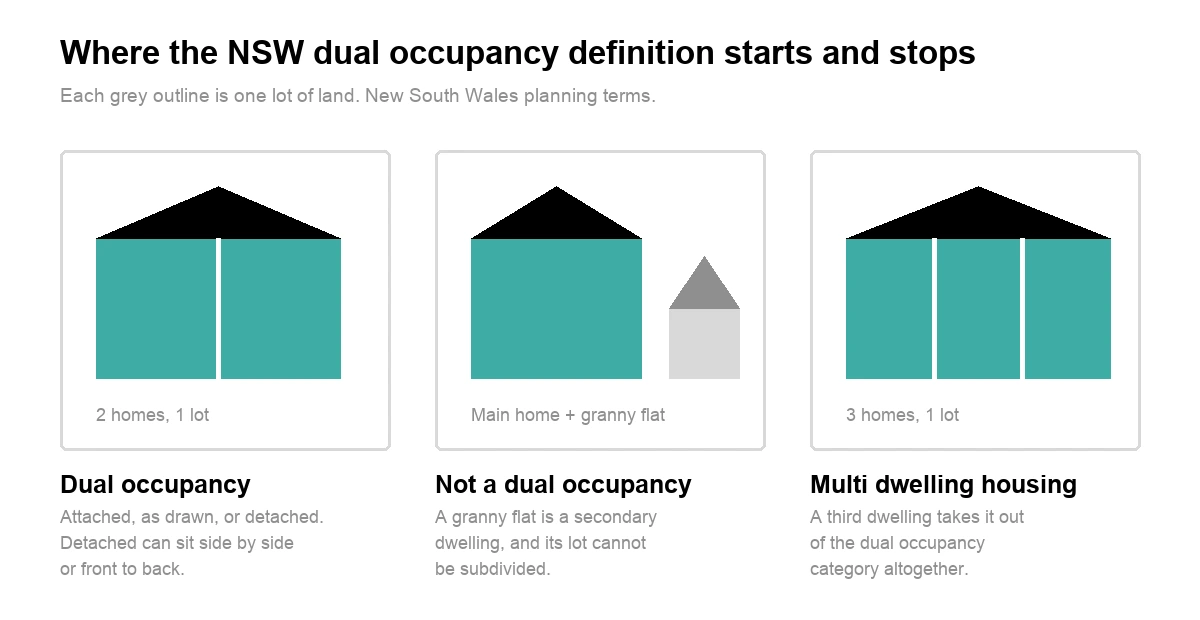
New South Wales planning has one category for two homes on a lot and a different category for three or more. The NSW Department of Planning, Housing and Infrastructure (2025) describes the first as two homes built on one lot, attached or detached, and its planning term for that is “dual occupancy”. The term has its own guide, if you want it: dual occupancy homes.
Cross the line to three, and the category changes. The department (2025) defines the second one as “Multi dwelling housing means 3 or more dwellings (whether attached or detached) on one lot of land, each with access at ground level”. A second departmental page repeats the same threshold in slightly different words.
Notice what’s missing from both. Neither category mentions a townhouse or a villa.
Duplex vs townhouse: what actually changes for a buyer?
In New South Wales, a duplex and a townhouse sit on opposite sides of the two-versus-three-or-more line. That line sets the planning category and the number of neighbours built beside you; how much is shared, and who votes on it, is set by the title and any strata scheme on it.
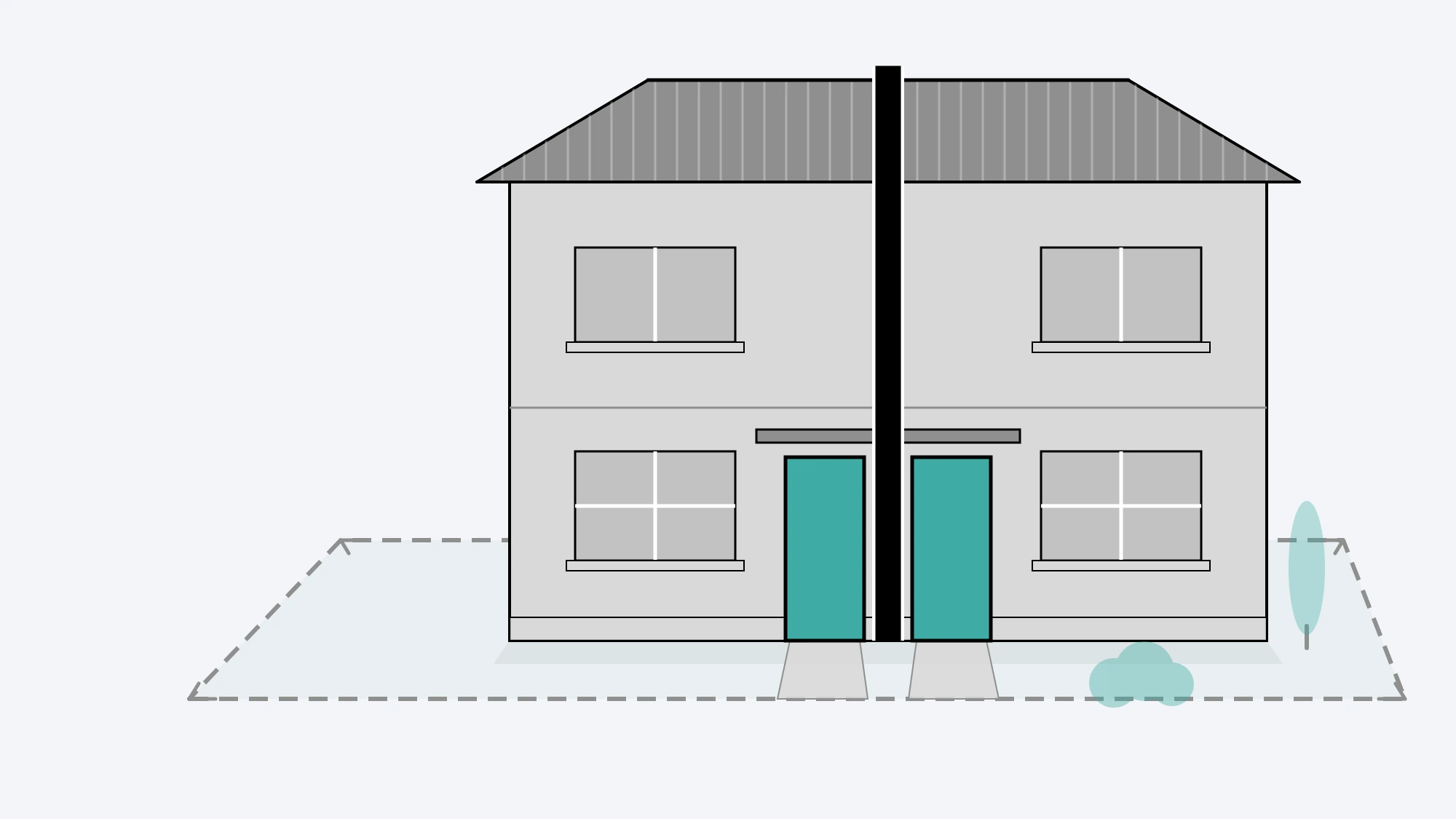
Start with the building. A duplex, in its attached form, is one structure divided down the middle. In New South Wales the attached form is two dwellings on a single lot, joined by what the department calls “a common wall (also known as a partition wall)” (2025). It is one building with two front doors, sitting on one block of land.
What listings call a townhouse commonly sits in the New South Wales three-or-more category. More neighbours, and, where the complex is a strata scheme, land around the buildings that’s common property rather than divided.
Then comes the part that reaches your bank account, and it is not the architecture. It is how many people have a say, and that is set by the title, not the dwelling count. In a New South Wales strata scheme, the shared parts of the property are managed collectively. The wall you share and the driveway you park in both sit on Fair Trading’s common-property list, alongside “swimming pools, gardens” and the “roofs, pipes, electrical wiring” (2026). Larger schemes typically involve more owners, and can involve more common property to make decisions about.
Semi-detached vs duplex: the difference is the land
In New South Wales, an attached duplex is two side-by-side dwellings on one lot. A semi-detached dwelling can look almost identical, but its land has been divided. The New South Wales department (2025) describes semis as “side-by-side dual occupancies that have been subdivided down the middle, so each house sits on its own lot”. The building stays the same; the land beneath it is what changed.
Why that matters to you: in New South Wales, the same-looking pair of homes can sit under different title arrangements. Separate registered lots may mean there is no owners corporation or common property, although easements or other shared obligations can remain. A two-lot strata scheme can still have common property and shared responsibilities. And without subdivision, the development remains a dual occupancy on one lot. A listing that says “semi” may be using the word loosely; the statutory definition requires the dwelling to sit on its own lot. The title tells you which arrangement you are actually buying.
Townhouse vs villa: what separates them in NSW planning?
In New South Wales planning, nothing separates them: both are multi dwelling housing. The one-storey-versus-two-storey split is real on the street, but it is common usage, not a legal boundary.
The department itself frames it that way, in a single sentence: two-storey forms are “commonly known as townhouses and single-storey forms as villas” (NSW Department of Planning, Housing and Infrastructure, 2025). “Commonly known as” is a description of what people call things, not a definition of a legal category.
In New South Wales the ownership rules do not distinguish them either: Fair Trading’s definition of a strata scheme reaches “an apartment, townhouse or villa” without drawing any line between the last two (2026). Neither label tells you whether a property is strata; the title does.
So what is a villa in Australia?
There is no neat official answer we could verify.
The one national instrument that names it, the National Construction Code, lists “villa unit” only as an example of a Class 1a building, alongside a row house, a terrace house and a town house (Australian Building Codes Board, NCC 2025). Named, but not defined. On the board’s own plain-English summary of that same clause, “villa” does not appear at all, replaced by “town house, row house or the like”.
Nor does it appear as a standalone category in the other government sources we reviewed. The word appears nowhere on the NSW department’s summary of key provisions, nor in any of the dwelling categories in the Australian Bureau of Statistics Census dictionary. Brisbane City Council (undated) lists examples of its multiple-dwelling category as “apartments, flats, units, townhouses, row housing”, and villas aren’t among them.
“Villa” is commonly used in the market for a single-storey home in a complex, but we could not verify a standalone legal test behind the label. Treat it as a description of the building, and go to the title for everything else.
What actually differs between the four, and what doesn’t?
| Duplex | Semi-detached | Townhouse | Villa | |
|---|---|---|---|---|
| Dwellings in the development | 2 | 2 | 3 or more | 3 or more |
| Lot arrangement in the NSW planning description | One lot of land | Each home on its own lot of land | One lot of land | One lot of land |
| How NSW planning describes it | Dual occupancy | Semi-detached dwelling following subdivision | Multi dwelling housing | Multi dwelling housing |
| Storeys implied by the label | Not specified | Not specified | Two, in common NSW usage | One, in common NSW usage |
| What the label tells you about shared costs | Not enough. Check the title. | Not enough. Check the title. | Not enough. Check the title. | Not enough. Check the title. |
Every row is New South Wales only: these categories are written state by state, and other states use different vocabulary entirely. The full state-by-state comparison, verified against each jurisdiction’s own planning instrument, is in our duplex guide.
Related terms: terraces and apartments
For other three-or-more forms, the department’s summary describes terrace housing as “3 or more attached dwellings facing the street on 1 lot”. The same summary uses “residential flat building” for “3 or more apartments in a 2 or more storey building” (NSW Department of Planning, Housing and Infrastructure, 2025). These are short descriptors from a summary table rather than full definitions, so treat them as signposts.
The National Construction Code can put a house, a townhouse and a villa in the same class
One more rulebook, briefly, because it shows how little the listing label settles. The National Construction Code, the instrument that names a villa unit without defining it, classifies buildings for construction purposes. The class where that villa example lives, Class 1a, also covers a “detached house” and other attached dwellings “separated by a fire-resisting wall” (Australian Building Codes Board, NCC 2025). Apartment buildings sit in a different class. The code doesn’t name a semi or a duplex, but a home marketed as either could meet the Class 1a description if the building satisfies that test. The Census draws its own boundaries too: the Australian Bureau of Statistics (2021) groups semi-detached houses, terraces and townhouses into one category, split only by storeys.
So the four words on the listing pass through at least four different systems, and none of them asks what the listing says. The listing tells you what the property is called. New South Wales planning tells you how the development is classified. The building code answers construction questions. The title tells you what you actually own.
Who votes on your money once the scheme is strata?
You and every other owner in the scheme do. Two numbers shape what that means in practice: how many strata lots share the scheme, and what share of its costs your lot carries. What follows is the New South Wales position, because strata sits inside state law.
A duplex can also be strata-titled, and this is where the word “lot” gets confusing, because it means two different things. In the planning description, the lot is a lot of land: a dual occupancy is two dwellings on one of them. In a strata scheme, “lot” means a strata lot — the scheme is “a building or group of buildings that has been divided into ‘lots’” (NSW Fair Trading, 2026) — so each home in a duplex can be its own strata lot, and NSW Fair Trading (2022) counts duplexes among two-lot schemes. One lot of land, two strata lots: both descriptions can be true of the same pair of homes at once. Check the title rather than taking the listing’s word for it.
Start with the count. In any New South Wales scheme, the owners corporation “includes all the property owners” and “manages the scheme’s buildings and common property”. Owners “elect a strata committee each year” at the annual general meeting (NSW Fair Trading, 2026).
At two lots, the owners corporation is you and one neighbour: only two ownership interests are involved. In a larger scheme, decisions can be made without your support, depending on the voting rules that apply — and those rules sit in the strata legislation.
How the levy is set: approve the amount, then charge by entitlement
Levies show it most clearly. NSW Fair Trading (undated) states that they “are approved by the owners corporation at the annual general meeting”, and that “over 50% of owners must vote in favour to approve the proposed levy amount”. It adds that levies “must be charged according to each property’s ‘unit entitlement’”. That is the regulator’s plain-English sketch of the process rather than the statute itself, but the two-step shape survives the simplification: the owners corporation approves the levy amount, then each lot’s share of it is charged by unit entitlement rather than split evenly. Two homes that look alike can carry different unit entitlements, so an identical-looking neighbour can pay a different share.
The money has somewhere to go, too. A New South Wales scheme must hold an administrative fund for “day-to-day expenses”, and a capital works fund, “previously called a ‘sinking fund’”, for capital expenses “when they arise” (NSW Fair Trading, 2026). Both are compulsory, and both are budgets you inherit on settlement: the saving and spending decisions of every owner before you are already sitting in those balances when you buy in.
None of this makes a townhouse a worse buy than a duplex. It makes it a different one, with more owners in the decisions. What you own inside the scheme is a separate question, and it turns on the title type rather than the dwelling type. We have set out how title type changes what you own for the duplex case.
What to ask before you sign
Three questions that work for any of the four types:
- How many lots are in the scheme, and what is my unit entitlement as a share of the total?
- Can I see the 10-year capital works plan? In New South Wales an owners corporation “must make a 10-year capital works plan” that “predicts what major repairs might be needed and forecasts their costs” (NSW Fair Trading, undated).
- Which parts of what I am walking through are common property, including the driveway and the wall I share?
What does the label tell you, and what doesn’t it?
Villa and townhouse aren’t legal categories on any government page we could verify. Semi-detached dwelling is one, in New South Wales planning. So the four words aren’t four equivalents, and none of them is a reliable guide to what you’d own.
What is genuinely written down is narrower and more useful. In New South Wales, two homes on a lot and three or more sit in different planning categories, with townhouses and villas both in the second and separated only by how many storeys people expect. Nationally, the building code treats a detached house, a terrace, a townhouse and a villa unit as one class, and puts apartment buildings in a different class. Beyond that, no Australian government source we could verify defines a villa or a townhouse at all.
So use the label to picture the building, then stop. Count the homes on the land, read the title, and ask how many owners will be voting on the budget you are about to join. Your conveyancer or solicitor confirms what the title and the contract actually say. The questions about the block itself, and what could change around it, are yours to check.
A knest.ai property report shows the site risks a listing leaves out: flood and bushfire exposure, zoning, power lines and noise. Those are the same for a villa, a townhouse and a duplex on the same street.
View a sample reportFrequently asked questions
What is the difference between a townhouse and a duplex in Australia?
The count. In New South Wales, a duplex is two homes on one lot, which NSW planning calls a dual occupancy. A townhouse sits in the three-or-more category, which the NSW Department of Planning, Housing and Infrastructure calls multi dwelling housing. More homes means more owners voting on shared costs, and in a strata scheme more common property to manage.
Is a townhouse better than a duplex?
Neither is better as a category, because neither word is a legal status. The practical trade-off is how many owners share the decisions. A duplex in a two-lot strata scheme means one other owner. A townhouse complex means more owners: in New South Wales, NSW Fair Trading says levies are approved by over 50% of owners and charged by unit entitlement.
What is the difference between a villa and a townhouse?
In New South Wales planning, nothing legal. Both are multi dwelling housing, and the NSW Department of Planning, Housing and Infrastructure notes that two-storey forms are “commonly known as townhouses and single-storey forms as villas”. That is a description of common usage, not a legal definition, and no Australian government source we could verify defines either word.
Is a semi-detached house the same as a duplex?
Nearly, and in New South Wales the difference is on paper rather than in the bricks. The NSW Department of Planning, Housing and Infrastructure describes semi-detached homes as side-by-side dual occupancies that have been subdivided down the middle, so each house sits on its own lot. Same shared wall, two lots instead of one.
Is a duplex a house?
It depends who is asking. The National Construction Code puts a detached house in Class 1a, and puts attached dwellings there too where a fire-resisting wall separates them. The Australian Bureau of Statistics separates them, because its test for a separate house is that it is “structurally independent from other dwellings”, and a home that shares a wall is not.
Sources
- Australian Building Codes Board, Part A6 Building classification, National Construction Code 2025 Volume Two, undated, retrieved 2026-08-13, https://www.abcb.gov.au/editions/ncc-2025/adopted/volume-two/a-governing-requirements/part-a6-building-classification
- Australian Building Codes Board, Building classifications, NCC Navigator, undated, retrieved 2026-08-13, https://ncc.abcb.gov.au/ncc-navigator/building-classifications
- Australian Bureau of Statistics, Dwelling structure (STRD), Census Dictionary 2021, retrieved 2026-08-13, https://abs.gov.au/census/guide-census-data/census-dictionary/2021/variables-topic/housing/dwelling-structure-strd
- Australian Bureau of Statistics, Housing Variables, 2020, retrieved 2026-08-13, https://www.abs.gov.au/statistics/standards/housing-variables/latest-release
- NSW Government, Standard Instrument—Principal Local Environmental Plan, Dictionary, in force, retrieved 2026-08-27, https://legislation.nsw.gov.au/view/html/inforce/current/epi-2006-155a
- NSW Department of Planning, Housing and Infrastructure, Unpacking low-rise housing, 21 February 2025, retrieved 2026-08-13, https://www.planning.nsw.gov.au/policy-and-legislation/housing/low-and-mid-rise-housing-policy/unpacking-low-rise-housing
- NSW Department of Planning, Housing and Infrastructure, Frequently asked questions, Low and Mid-Rise Housing Policy, 17 December 2025, retrieved 2026-08-13, https://www.planning.nsw.gov.au/policy-and-legislation/housing/low-and-mid-rise-housing-policy/frequently-asked-questions
- NSW Department of Planning, Housing and Infrastructure, Summary of key provisions, 21 March 2025, retrieved 2026-08-13, https://www.planning.nsw.gov.au/policy-and-legislation/housing/low-and-mid-rise-housing-policy/summary-of-key-provisions
- NSW Government (Fair Trading), Buying a strata property, 1 April 2026, retrieved 2026-08-13, https://www.nsw.gov.au/housing-and-construction/strata/buying-a-strata-property
- NSW Government (Fair Trading), Levies, undated, retrieved 2026-08-13, https://www.nsw.gov.au/housing-and-construction/strata/serving-on-a-committee/levies
- NSW Government (Fair Trading), Managing strata finances and insurance, 22 June 2026, retrieved 2026-08-13, https://www.nsw.gov.au/housing-and-construction/strata/serving-on-a-committee/finances-insurance
- NSW Government (Fair Trading), Managing strata repairs and capital works, undated, retrieved 2026-08-13, https://www.nsw.gov.au/housing-and-construction/strata/serving-on-a-committee/repairs-capital-works
- NSW Fair Trading, How two-lot strata schemes can easily tackle reporting, 22 August 2022, retrieved 2026-08-11, https://www.nsw.gov.au/departments-and-agencies/fair-trading/news/two-lot-strata-schemes
- Brisbane City Council, Multiple dwellings, undated, retrieved 2026-08-13, https://www.brisbane.qld.gov.au/building-and-planning/getting-started-on-your-project/residential-projects/multiple-dwellings
Daniel Ryan, Editor, Buyer Guides & Property, knest.ai
General information only. This article is general information for Australian home buyers. It isn’t personal legal, financial, credit or tax advice, and it isn’t a property valuation. Planning, building and strata rules differ by state and change over time. Check your own situation with a licensed conveyancer or solicitor in the relevant state. knest.ai is an AI property-intelligence platform that supports buyer judgment. It isn’t a conveyancer, a solicitor or a legal service, and it doesn’t replace one.